
There’s a wall in Port Elizabeth Central that most people have passed a hundred times without really seeing. For years, it was just noise — layers of tags, half-finished scrawls, the kind of surface the eye slides off without registering. Then, one day, it wasn’t. Somebody picked up a brush instead of a can, and the noise became a picture. Same wall. Same city. A completely different reaction from everyone who walked past it.
So, what actually separates “graffiti” from “art”? Is it the image itself — or is it who gave permission for it to be there?
Port Elizabeth has lived this exact story before. Back in 2013, a group of local artists — Nathan Sanan, Steven Carter, Paolo Maneli and Quintin Weyer — approached the developers behind the Something Good roadhouse overlooking Pollok Beach with an idea: take a wall that had become a magnet for graffiti, and turn it into a proper mural. Sanan, an architect by trade, said the goal was simple — to share their love of urban art and “instil a sense of pride” in residents, using colour and craft to push back against the tagging that had taken over the space.

What stands out in that story isn’t really the mural itself. It’s the admission buried inside it: the wall was already a canvas. People were already using it to say something. The artists didn’t introduce art to a blank space — they replaced one form of expression with another, one the city was willing to call legitimate.
A few streets over, Central has its official answer to that question, unmissable and fully sanctioned: Route 67, the public art trail that winds up toward the Donkin Reserve through 67 individual works — murals, mosaics, sculpture — each one marking a year of Nelson Mandela’s public life. The Bus Station Mural alone, painted by the collective 4 Blind Mice, was designed specifically to celebrate the everyday commuters who pass through it. It’s vivid, civic-minded, and it was commissioned by the Mandela Bay Development Agency on behalf of the municipality.
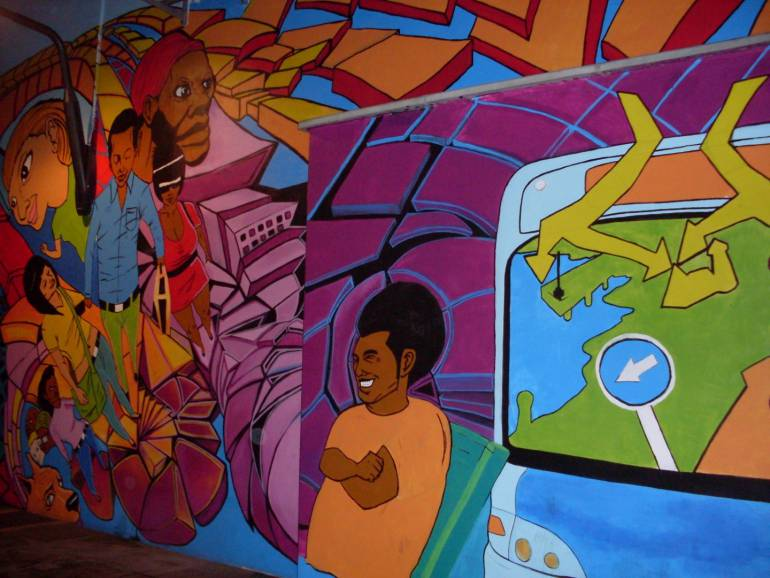
Nobody debates whether Route 67 is “art.” It has a plaque. It has a budget line. It has permission. And that is arguably the actual dividing line in most people’s minds — not talent, not colour, not even permanence. Permission. The same aerosol can, the same wall, the same skill with a spray nozzle can be called vandalism or heritage depending entirely on whether someone in an office signed off on it first. Here’s the part more interesting than the semantics: how many people actually stop for any of it anymore?

Route 67 was built to be walked slowly — to draw a pause at the Voting Line sculpture, an exchanged word with a stranger, a moment to listen for the Campanile’s bells. But most of Central moves past its own art at commuter speed. People will queue for a gallery opening and not glance twice at a mural they drive past every single day. Somewhere along the way, “art” became something you go and see, on purpose, in a building designed for the purpose — and everything else became scenery.
Maybe that’s the real question hiding behind “art or graffiti.” It isn’t really about definitions. It’s about attention. A tag gets read as vandalism partly because no one was invited to slow down and look at it. A mural gets read as art partly because someone put a frame around the moment — a plaque, a launch event, a story in the newspaper — and declared it worth a second look.
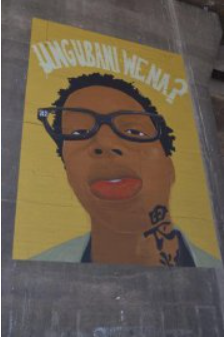
Looking at the paintings in Central, the point isn’t to settle on a label before looking closely. It’s what happens in the half-second before that decision gets made. Is it intention, or intrusion? Craft, or clutter? And if the answer changes once the question of permission comes up — what does that say about what “art” actually means?
Because if Port Elizabeth’s own walls can flip from vandalism to civic pride with nothing but a fresh coat of paint and a press release, maybe the line was never about the image at all.
What’s your take?


