Mass Enrollments Reflect the Impact of the “Revealed Word”: 181 New Pastors Join Educational Program
On 10 September 2025, the Shincheonji Church in Ethiopia held a special ceremony during which 84 pastors committed to preaching the Word of the New Covenant Revelation and officially adopted the name “Shincheonji Church of Jesus, the Temple of the Tabernacle of the Testimony” for their churches.
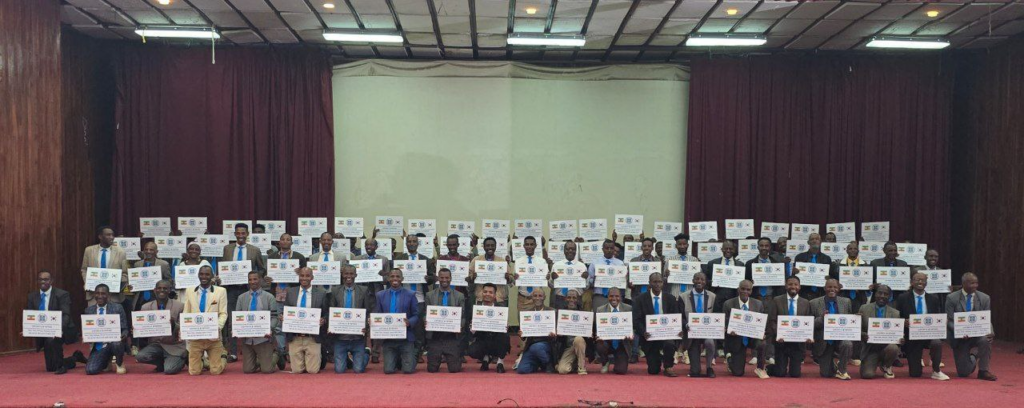
On the 10th, representative pastors from 84 churches in Ethiopia posed for a commemorative photo at the “Shincheonji Church of Jesus, the Temple of the Tabernacle of the Testimony, Peter Tribe, Ethiopia Signboard Changing Ceremony.”
This development follows the participation of Pastor Asefa Angeto, President of the Misgana Denomination Association, in the 2nd Global Invitation Revelation Seminar held last November at a Shincheonji Church of Jesus branch in Cheongju, South Korea. After returning to Ethiopia, Pastor Asefa travelled to more than 100 churches in 10 cities, conducting seminars and testifying to the revealed Word he learned.
The change of signage that the 84 churches have made is regarded as more than a simple name change; it marks a major breakthrough in spreading a Word-centered transformation within the Ethiopian Christian community.
At the commemorative ceremony, the representative pastors of the 84 churches declared that, as members of Shincheonji Church of Jesus, they had fully learned the Word of the New Covenant Revelation and were now determined to teach it to all believers, “We resolve to preach this Word throughout Ethiopia, so that both pastors and believers alike may follow only the truth and devote themselves more fervently to the ministry of the Word.”
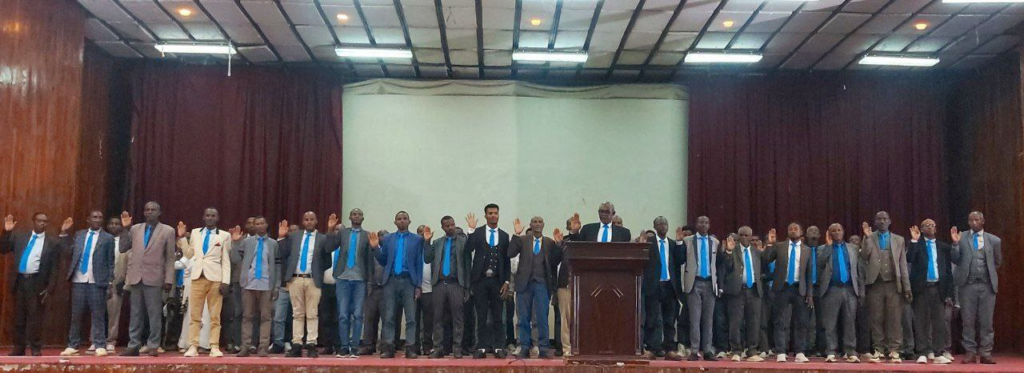
The “Shincheonji Church of Jesus, the Temple of the Tabernacle of the Testimony, Peter Tribe, Ethiopia 84 Churches Signboard Changing Ceremony,” representative pastors from all 84 churches conducted a pledge ceremony.
A representative of Shincheonji Church of Jesus stated that 181 pastors in Ethiopia are currently learning the revealed Word from Shincheonji Church of Jesus, “We will continue to make known the fact that the prophecies of Revelation have been fulfilled today, and we will do our utmost so that churches around the world may become united through the Word.”
“Based on Rev 22:18-19, Examine Yourself: Have You Kept the Word According to the Bible?”First of Its Kind Overseas with Significant Pastor Participation… Expanding Scripture-Centered Fellowship
On the 18th, Shincheonji Church of Jesus, the Temple of the Tabernacle of the Testimony, Peter Tribe, Tanzania Church (led by Head Instructor Yoon Hyun-chul, hereafter referred to as Shincheonji Tanzania Church) conducted an open Revelation Bible exam with local Protestant pastors and Shincheonji members in major cities, including Dar es Salaam, Tanzania.
Local Tanzanian pastors and Shincheonji members who took the “Open Revelation Bible Exam” on the 18th pose for a commemorative photo holding their exam papers.
The purpose of this exam was to evaluate whether believers who hope for heaven have kept the words of Revelation (Rev 22:18-19) and to encourage each person to stand rightly before God. The exam consisted of 10 main questions and 33 sub-questions, all centered on Revelation. Participants reflected not just on knowledge, but on whether they truly believed and practiced according to the Word.
A total of 138 participants took the exam, including 98 local Protestant pastors and 40 Shincheonji members. Unlike last year’s exam in Korea, where only one pastor from a traditional denomination participated, this marked the first time a large number of pastors overseas took part.
Local Tanzanian pastors and Shincheonji members who took the “Open Revelation Bible Exam” on the 18th pose for a commemorative photo holding their exam papers.
The results showed a notable difference between groups (Shincheonji members scored an average of 95 points, while Protestant pastors scored an average of 7 points). However, the primary goal was not to rank participants, but to create an opportunity for self-reflection through Revelation and to draw closer to God.
One participating pastor mentioned “Seeing Shincheonji members write their answers so confidently today made me reflect on my faith and calling as a pastor. I will study Revelation through the Shincheonji Zion Christian Mission Center, lead my congregation on God’s path, and teach them correctly so they can enter heaven.”
A Tanzanian Protestant pastor answering questions during the “Open Revelation Bible Exam” on the 18th.
Chairman Lee Man-hee of Shincheonji Church of Jesus has consistently emphasized Revelation 22:18–19, saying, “To enter heaven, one must not add to or subtract from the words of Revelation, but fully understand and keep them.”
He has also stated, “The standard for discerning truth and falsehood, orthodoxy and heresy, is not human tradition or doctrine, but the Word of God alone, highlighting the necessity of testing faith by the Bible.
Previously, Shincheonji Church of Jesus held a similar Bible exam in Korea with pastors from traditional churches, drawing attention at the time. Among 313 participants, only one pastor from an established denomination joined. This Tanzanian event, therefore, is significant as the first instance of large-scale pastor participation overseas.
A Shincheonji Church representative commented, “The Bible exam is not just a test of knowledge, but a way to confirm whether one’s standard of faith is truly the Word of God. We are grateful that more pastors are gradually joining both domestically and internationally. We hope more churches and believers will unite and interact based on Scripture.”
Meanwhile, since its establishment in 2018, Shincheonji Tanzania Church has grown steadily, with about 2,440 members as of August this year. The church continues to work toward spreading Scripture-centered faith through active exchanges with local pastors.
When amapiano royalty throws a party, the entire country shows up. That’s exactly what happened this past weekend as DJ Maphorisa and Kabza De Small—better known as the Scorpion Kings—brought Pretoria to a standstill with their sold-out Scorpion Kings Live with Friends concert at Loftus Versfeld Stadium. The show wasn’t just a celebration of music; it was a bold statement about cultural ownership, artistic elevation, and amapiano’s undeniable global rise.
Over 50,000 fans filled the iconic stadium on Saturday, August 29th, drawn in by a lineup that blurred genres, united generations, and delivered the kind of sonic and visual experience that South African stages rarely see. From the moment gates opened early in the afternoon, energy buzzed through the venue. Fans who arrived as early as 1PM were treated to a vibrant pre-show lineup that felt more like a festival than a warm-up. Acts like DBN Gogo, Dlala Thukzin, 25K, and Vinny Da Vinci kept the party going long before the headliners touched the stage.
And when they did? The atmosphere shifted from celebration to spectacle. A rotating stage ensured every angle of the stadium had front-row access, while massive LED screens, lasers, and drones turned the performance into a cinematic, 360-degree experience. The production quality raised the bar not just for local concerts, but for live music events across the continent.
Yet beyond the lights and sound, Scorpion Kings Live was deeply emotional. The show opened with a heartfelt prayer by DJ Maphorisa’s mother—a grounding moment that reminded everyone this wasn’t just business; it was personal. Later in the evening, a moving tribute was paid to legendary composer Caiphus Semenya, whose family accepted honors on his behalf while Kabza remixed some of his most iconic tracks. In a genre often dominated by fresh sounds, this respectful nod to the past struck the perfect chord.
The headline acts shared their stage with a powerhouse guest list: Davido, Kamo Mphela, Ami Faku, Sjava, Cassper Nyovest, Focalistic, Young Stunna, Kwesta, Nkosazana Daughter, Makhadzi, and more. Each artist brought their own flavor, but together, they told one cohesive story—of South African music as a force to be reckoned with on the world stage.
Social media hasn’t stopped buzzing since the last beat dropped. From aerial shots of the massive crowd to fan reactions that ranged from teary-eyed gratitude to absolute disbelief, it’s clear this wasn’t just a good night—it was a transformational one. One fan tweeted: “This felt like our own Super Bowl halftime show.” Another wrote: “I’ve never been prouder to be part of this culture.”
In the days that followed, questions were raised online about funding for such a massive production. The National Youth Development Agency (NYDA) was quick to clarify: no public money was used. In fact, the event empowered young South Africans by involving them in production roles like ushering, logistics, and stage support—an important detail that speaks to the concert’s broader vision of inclusion and empowerment.
More than just a concert, Scorpion Kings Live with Friends was a watershed moment. It proved that amapiano is not just thriving—it’s thriving with excellence, unity, and intention. It also proved that local artists can host large-scale, high-quality events without compromising authenticity or community values.
As fans spilled into the streets of Pretoria after the final song, one thing was clear: amapiano is no longer emerging—it has arrived. And if Maphorisa and Kabza’s subtle hints are anything to go by, this may be the first in a series of cultural events that continue to put South African music—and South African production—on the global map.
Making friends as an adult often feels harder than training for a marathon in flip-flops. Somewhere between juggling work, family, and bills, our social lives shrink—while our couches, streaming services, and food delivery apps take over. From shifting values to solo survival, the social fabric is fraying. But like any good braai—solid foundation, a bit of effort, and the right vibe—you can rekindle friendship in your 30s and beyond.
According to the 2025 October Health Limited report, roughly 13.7% of the South African population overall experiences loneliness, a silent challenge with real consequences – like depression, cognitive decline, and even workplace disengagement. Rapid urbanisation also pulls people away from traditional support systems. Migration, economic pressures, and long commutes often dilute community ties. Modern work structures—especially remote and flexible setups—are depleting those casual water-cooler friendships. People now spend significantly less time socially—with for the better part of two decades, South Africans hanging out ~20 hours less per month. Another hard truth we need to face, with the crime rate in SA we run vibe checks and security checks at the same time.
Rethinking What Friendship Looks Like: How to Hack Adult Friendship
2. Tap into local community spaces Activity-focused groups like Rover Crews (part of Scouts South Africa) in places such as Irene offer welcoming, affordable social hub.
3. Keep showing up Whether it’s your favourite café, a weekly class, or a volunteer project, routine breeds rapport. The simple act of repeat presence can transform strangers into potential friends.
4. Be the one to ask Friendships don’t happen on autopilot. Inviting someone out—despite the risk of rejection—can lead to meaningful bonds.
5. Let down your guard (gently) Authenticity connects. As seen in local research, workplace friendships—especially among professional women—can unlock personal honesty and provide a safe space to be yourself
6. Acknowledge time and energy gaps Like anywhere else, friendships here need time to blossom—especially when everyone’s balancing family, financial pressures, and long workdays.
7. Let go of forever-friend pressure Not every friend has to last forever. Some are seasonal, others full-time—both have their place. The key is to cherish connection wherever it blooms.
Perhaps the biggest shift is letting go of the fantasy that friendships in adulthood should be effortless or lifelong. Some bonds are seasonal, others last decades. Both can be meaningful. In your 30s, 40s, and beyond, friendship is less about constant availability and more about consistent effort. Show up, stay open, and remember: building a circle takes time—but every connection is worth the investment.
Taking its title from the global hit by Miley Cyrus, I Can Buy Myself Flowers is a sharp and entertaining one-woman comedy-drama about Natalie Jackson, a fifty-something estate agent who reflects on the rollercoaster of relationships, raising children, career ambitions, and the value of women’s friendships.
Natalie, portrayed by Erika Breytenbach, embodies the contradictions of her generation: old enough for multiple marriages, young enough to be unburdened by apartheid’s legacy, and woman enough to face menopause with humor and grit. Alongside five close friends—collectively dubbing themselves the “Six-in-the-City” WhatsApp group—she navigates the triumphs and insecurities that come with professional and personal life. Years of therapy, the inspiration of female colleagues, and the challenges of patriarchal family structures shape her journey toward living unapologetically on her own terms.
Erika Breytenbach on stage.
The play is penned by acclaimed writer Mike van Graan, whose many honors include the Independent Theatre Award for My Fellow South Africans, and directed by Toni Morkel. Co-produced by MVG Productions and Unlikely Productions, the 65-minute show carries a PG16 age restriction and has been praised for its wit and relatability since premiering at Cape Town’s Drama Factory earlier this year.
Award-winning playwright, Mike van Graan.
Designed as a highly portable production, I Can Buy Myself Flowers has been staged at theatres, festivals, and unconventional spaces alike. After successful runs in Durban, the Garden Route, and at the National Arts Festival in Makhanda, it now makes its way to the Isithatha Theatre in Walmer on September 8 and 9 at 7.30pm.